
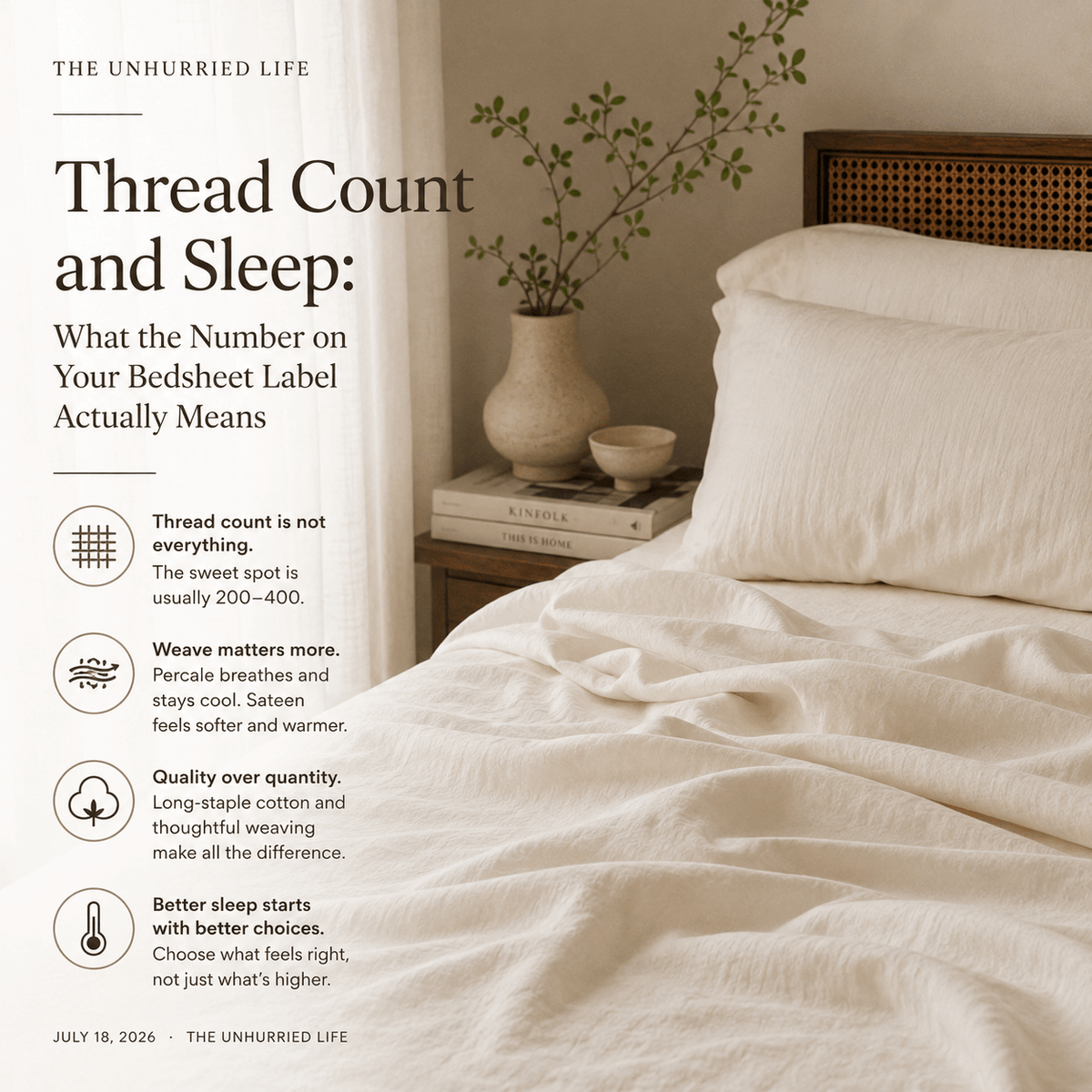
Somewhere along the way, thread count became the number we reach for when judging a bedsheet. Higher felt like better — 300, 600, even 1000 threads per square inch, printed proudly on the packaging. But if you have ever bought "premium" high-thread-count sheets only to find them heavy, warm, or oddly stiff, you already know the number does not tell the whole story.
At The Unhurried Life, we think of bedsheets the way we think about most things in a slow home — the label matters less than how something actually feels against your skin, night after night. So it is worth understanding what thread count really measures, where it stops being useful, and what to look for instead when you are choosing sheets for an Indian bedroom.
What thread count actually measures
Thread count is simply the number of horizontal and vertical threads woven into one square inch of fabric. In theory, a higher number means a denser weave. In practice, there is a physical ceiling to how many single-ply cotton threads can fit into that square inch — most textile experts put it around 400. Beyond that, manufacturers often use thinner, multi-ply threads twisted together and counted individually to inflate the number, which is how you end up with sheets marketed at 800 or 1000 thread count that do not actually feel finer or last longer than a well-made 300 or 400 count sheet.
The Sleep Foundation's guide to thread count notes that sheets in the 200–400 range, made from good quality cotton in a percale weave, are typically the most breathable and offer the best balance of softness and durability. Beyond that range, the returns diminish quickly, and in warmer climates, they can work against you.
Why very high thread counts can work against sleep
This is the part that surprises people. As thread count climbs, the weave tightens — there is simply less space between the threads for air to move through. A denser weave traps warmth close to the body instead of letting heat escape, which is the last thing you want on a humid April night in most of India. If you tend to sleep hot, an ultra-high thread count sheet can quietly work against you, holding onto body heat rather than helping you cool down through the night.
This is precisely why weave structure matters more than the number on the packet. A crisp, tightly-woven percale weave feels cool and breathable, closer to the crispness of a fresh cotton shirt, and it stays that way even in humidity. A sateen weave, with its smoother, lustrous finish, drapes with a bit more softness and warmth — a better fit for cooler months or air-conditioned rooms. Neither is "better" in absolute terms; they simply behave differently, and thread count alone cannot tell you which one you are holding.
What to check instead of the number on the label
If thread count is not the reliable shortcut it is marketed as, a few other things are worth your attention:
- Fibre quality and staple length. Long-staple cotton produces smoother, stronger yarn with fewer loose fibre ends, which means less pilling and a softer feel that actually improves with washing rather than degrading.
- Weave, not just count. Percale for a crisp, cool, matte finish; sateen for a softer, slightly warmer drape with a gentle sheen. Choose based on how you sleep, not the number printed on the pack.
- GSM (grams per square metre). For sateen especially, GSM is often a more honest indicator of fabric density and weight than thread count.
- How the fabric feels fresh out of the packet. Genuine long-staple cotton feels smooth and substantial from the first touch — it does not need an inflated number to convince you.
None of this is about chasing a bigger number. It is closer to how we think about the rest of a slow, considered home — choosing things because they are genuinely well made and suited to how you actually live, not because a label promised more.
Choosing sheets for real Indian nights
Most Indian bedrooms deal with heat and humidity for a large part of the year, which is exactly why breathability deserves more attention than it usually gets. A well-woven 300–400 thread count percale sheet, made from good cotton, will very often outperform a marked-up 800 count sheet on the nights that matter most — the ones where you just want to fall asleep without kicking off the covers at 2 a.m.
If you are building out your home linen collection, it is worth having both a percale and a sateen set on hand — one for the warmer months, one for when the air turns cooler — rather than searching for a single "perfect" thread count to solve for every season.
The next time you are comparing bedsheets, let the number on the label be one small data point, not the whole decision. Ask about the weave, the fibre, the feel. Better sleep rarely comes from a bigger number — it comes from fabric that was made well in the first place.