
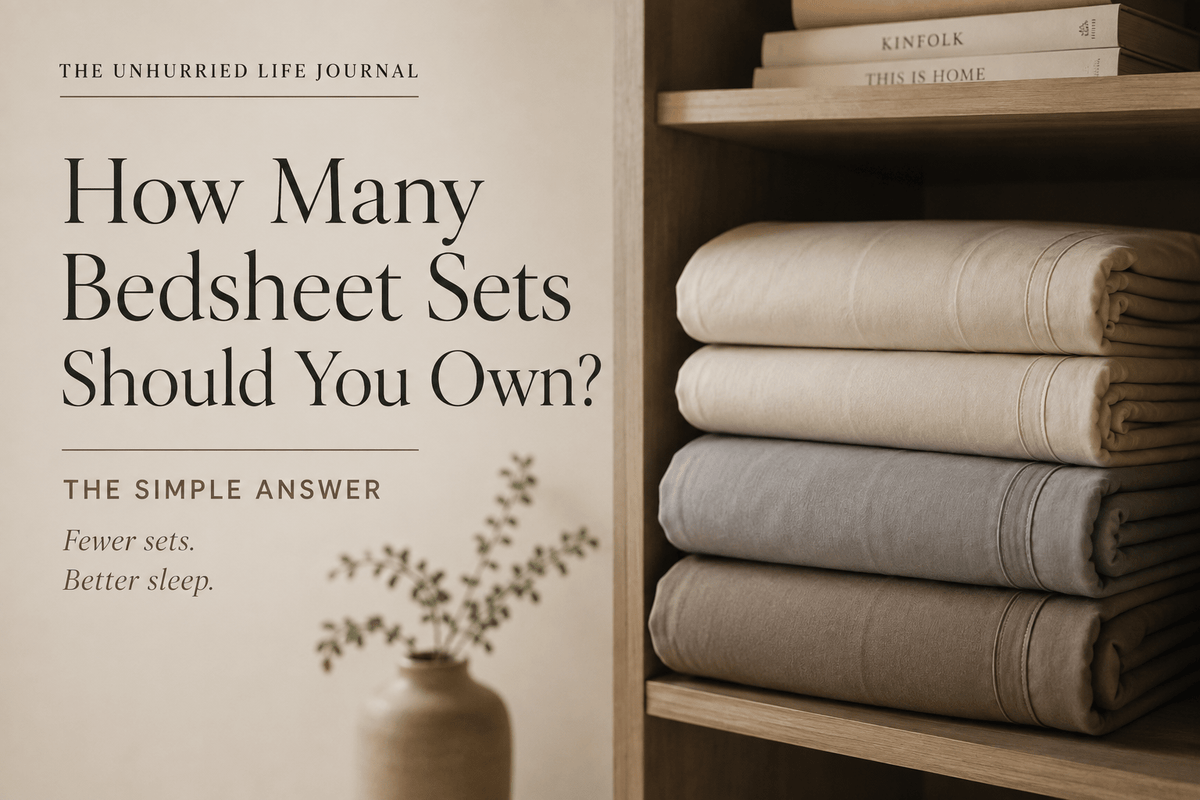
Open most linen closets and you will find the same story: a stack of bedsheets bought over the years, in slightly different sizes, half of them rarely used, one or two frayed sets kept out of habit rather than need. It is a quiet form of clutter — easy to overlook, but it takes up shelf space, decision-making energy, and money that could go toward fewer, better things.
The question isn't really how many bedsheets should I own. It is how few can I own and still sleep well every night. That turns out to have a fairly simple answer.
The short answer: three sets per bed
For most households, three well-made cotton bedsheet sets per bed is the sweet spot — one on the bed, one in the wash, and one in reserve. This isn't an arbitrary number. It maps directly onto how often sheets actually need washing.
The Sleep Foundation recommends washing sheets at least once a week, more often if you sleep without a top sheet, share your bed with a pet, or live somewhere warm and humid — which describes most of India for a good part of the year. A weekly cycle means one set is always drying or waiting to be ironed while another is in use. A third set covers the gap, and guards against the day the wash gets delayed.
Why the number changes with your household
Three is a starting point, not a rule. A few things push it higher or lower:
- Climate and humidity. In coastal or monsoon-heavy regions, sheets can feel damp or need washing sooner than the weekly average, which argues for a fourth set rather than rushing the laundry.
- Children or pets on the bed. More frequent accidents and washing mean the reserve set gets used more often, so it is worth having.
- Guest rooms. A guest bed used only occasionally needs just one or two sets, since there is no weekly rotation to plan around.
- Seasonal switching. If you move between a lighter percale weave for warmer months and a heavier sateen weave for cooler ones, you are effectively running two small capsules rather than one larger one — which still totals around five or six sheets a year, not the ten or twelve many closets quietly hold.
Quality changes the math
A closet of ten mediocre sheet sets usually exists because none of them are quite right — too thin, too clingy, pilling after a few washes — so more get added instead of subtracted. Three sets of genuinely good, long-staple cotton in a weave that suits how you sleep will outlast and outperform a drawer full of sheets bought as backups for backups.
This is really the same principle that shows up everywhere else in a considered home: fewer, better things, chosen deliberately, cared for properly. It is worth spending on the sheets that touch your skin for a third of your life, and worth resisting the ones bought only because they were on sale.
Building your own capsule
If your linen closet needs a reset, here is a simple way to approach it:
- Count what you currently own and set aside anything thinner than it should be, permanently stained, or a size you no longer use.
- Decide on two or three sets in a weave and weight that suits your climate and season.
- Donate or repurpose the rest — old cotton sheets make good drop cloths, cleaning rags, or garden covers rather than landfill.
- Replace gradually, not all at once, choosing quality over quantity each time.
A smaller, better-chosen linen closet is a small act of the same unhurried thinking that shapes the rest of a calm home — buying with intention, keeping what serves you, and letting go of what doesn't. For more on building a home around fewer, better choices, browse the rest of the journal.