
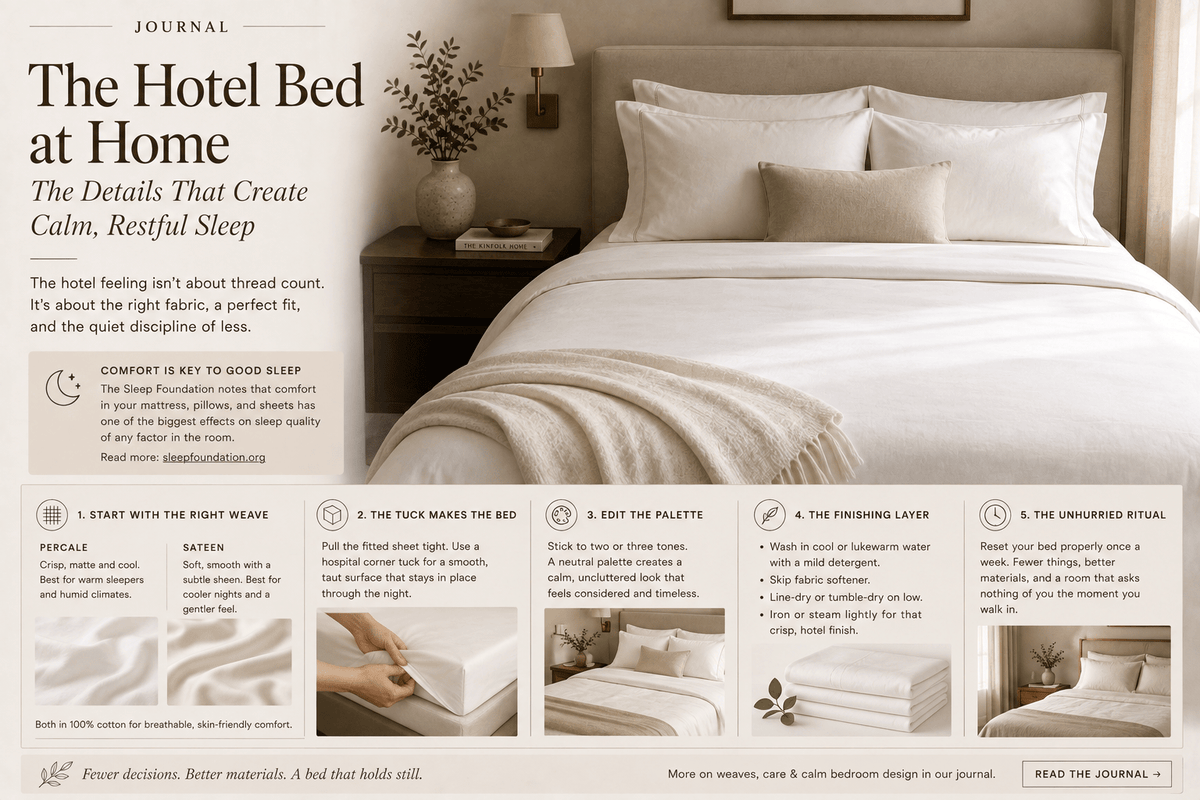
There is a particular stillness to a hotel bed. You set your bag down, sit on the edge of it, and something in your shoulders lets go. It isn't luxury in the expensive sense — most hotel rooms are furnished modestly. It's something quieter: the sheets are taut but not stiff, the surface is cool and even, and nothing about the bed is asking for your attention. That feeling is reproducible at home, and it has less to do with thread count marketing than with a few deliberate choices about fabric, fit, and restraint.
Why a Hotel Bed Feels Different
Housekeeping teams work with a narrow, tested set of variables: a crisp, breathable weave, a bed made tight enough that the sheet doesn't shift or bunch, and a palette kept to two or three tones at most. None of it is accidental. The Sleep Foundation's guide to bedroom design notes that comfort in your mattress, pillows, and sheets has one of the biggest effects on sleep quality of any factor in the room — more than most people expect from something as ordinary as bedding. A hotel bed isn't just aesthetically calm; it's built around the same principles that actually help you sleep.
Start With the Right Weave
Most hotels default to percale, and there's a reason for it. Percale is woven in a simple one-under, one-over pattern that produces a matte, paper-crisp finish and excellent breathability — it's the fabric equivalent of fresh linen closet air. If you tend to sleep warm, or you live somewhere humid for much of the year, percale from a percale collection will get you closest to that cool, hotel-corner snap.
If you prefer a softer hand-feel with a slight sheen — closer to what five-star suites often use in cooler climates — a sateen weave is the better match. Sateen has more thread floats per pattern repeat, which gives it a subtle drape and warmth. Browse a sateen collection if that's the texture you're after. Neither weave is objectively superior; the hotel feeling comes from picking the one suited to your climate and sleeping temperature, then committing to 100% cotton so the fabric breathes properly against skin.
The Tuck Makes the Bed
A flat, well-tucked fitted sheet is doing more work than any cushion or throw. Pull the fitted sheet corners taut before tucking the flat sheet and blanket into a snug hospital corner at the foot of the bed — this is what keeps the surface smooth instead of rippled, and it's the single biggest visual difference between a "made" bed and a genuinely calm one. If your fitted sheet is sagging or the elastic has gone slack, no amount of styling above it will fix the effect; it's worth replacing the set before it starts to look tired.
Edit the Palette, Not Just the Pillows
Hotels rarely mix more than two or three tones on a bed: a base sheet, a duvet or coverlet, and one accent. At home, this usually means resisting the urge to add another patterned cushion or a second contrasting throw. When you do want one accent, keep it to a single tonal cushion cover in a shade from the same palette as the sheet, rather than several competing prints. A single neutral palette across your home linen — bone, stone, or soft white — reads as more considered than a mix of prints, and it's also easier to launder and replace piece by piece as things wear. Fewer, better pieces is not just a slow living principle; it's a practical one for anyone tired of colour-matching four different sets.
The Finishing Layer: Scent and Feel
Hotel linens are laundered on a tight, professional cycle, which is part of why they smell and feel a certain way — faintly clean, never overly fragranced. You can get close to this at home by washing sheets in cool or lukewarm water with a mild detergent, skipping fabric softener (it coats cotton fibres and dulls their natural breathability over time), and line-drying or tumble-drying on low. A light iron or a few minutes on a steamer for the top flat sheet and pillowcases, if you have the patience for it, adds the last bit of crispness that separates a nice bed from a hotel one.
An Unhurried Version of the Ritual
None of this needs to happen every day. Even resetting your bed properly once a week — square corners, one clean palette, sheets that are actually 100% cotton rather than a cotton-blend that pills within a season — does most of the work. The rest is simply not adding things to the bed that don't need to be there. That restraint is, in its own small way, the same instinct behind slow living: fewer decisions, better materials, a room that asks nothing of you the moment you walk in. For more on building a bedroom around that idea, the journal has further reading on cotton weaves, care, and calm bedroom design.