
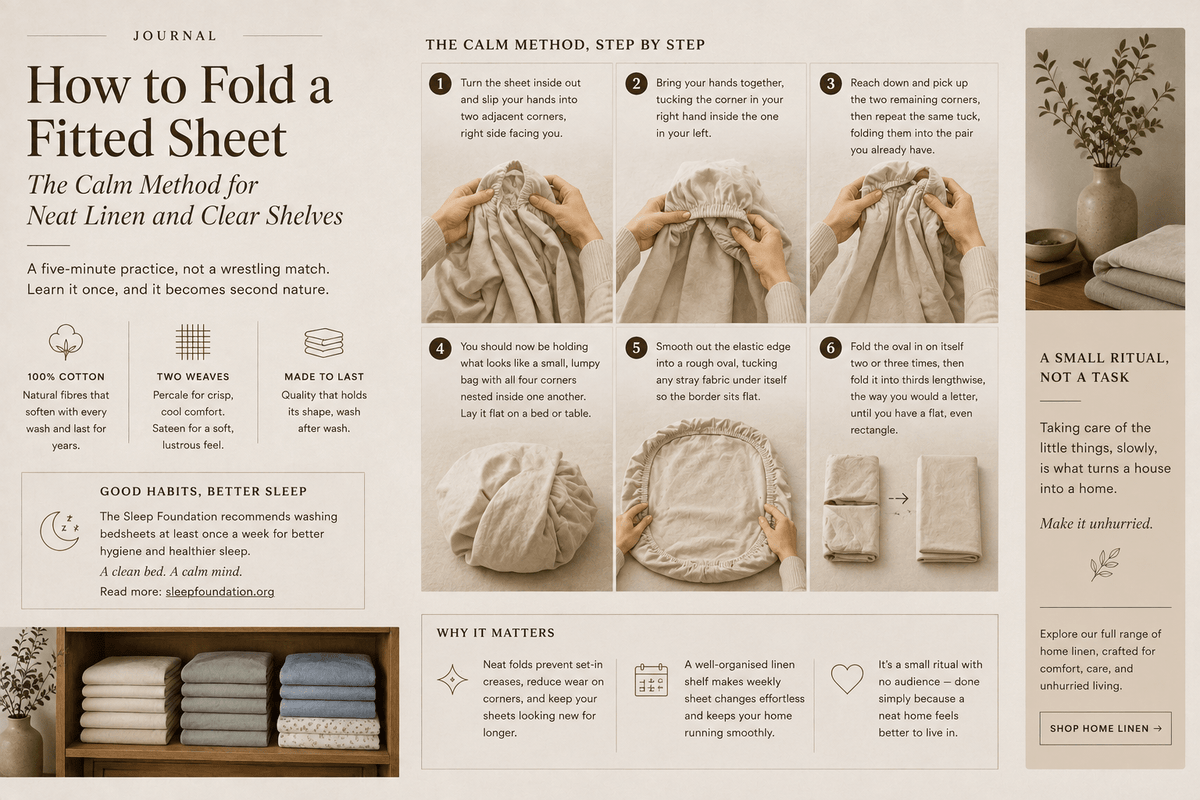
Of all the small chores a home asks of us, folding a fitted sheet is the one most likely to end in a crumpled heap shoved to the back of a shelf. It has no straight edges to align, no obvious rules to follow, and most of us have simply never been shown how. But like most things worth doing slowly, it becomes easy once you understand its logic. This is a five-minute practice, not a wrestling match, and it is worth learning properly.
Why the Fitted Sheet Feels Impossible
A flat sheet folds the way paper folds. A fitted sheet, with its elasticated corners, refuses that logic. Its four corners are designed to grip a mattress, not lie flat in a stack, and that single design choice is the entire source of the frustration. The trick is not to fight the elastic but to work with it, tucking each corner inside the next until the shape naturally collapses into a neat rectangle.
The Calm Method, Step by Step
This works for any 100% cotton fitted sheet, whether it is from our percale collection or our sateen collection. Both weaves hold a crease well once dry, which makes this method easier, not harder.
- Turn the sheet inside out and slip your hands into two adjacent corners, right side facing you.
- Bring your hands together, tucking the corner in your right hand inside the one in your left, so both fold neatly over each other.
- Reach down and pick up the two remaining corners, then repeat the same tuck, folding them into the pair you already have.
- You should now be holding what looks like a small, lumpy bag with all four corners nested inside one another. Lay it flat on a bed or table.
- Smooth out the elastic edge into a rough oval, tucking any stray fabric under itself so the border sits flat.
- Fold the oval in on itself two or three times, then fold it into thirds lengthwise, the way you would a letter, until you have a flat, even rectangle.
The first attempt rarely looks perfect, and that is fine. The shape gets easier to find with the third or fourth try, and most people stop thinking about it entirely within a week.
Why Technique Matters More Than You Think
A well-folded sheet is not just tidier to look at. Sheets stored loosely, twisted, or crushed under heavier linens tend to develop set-in creases that no amount of ironing fully removes, and long-staple cotton in particular holds its shape best when it is folded along the same lines each time. A flat, even fold also means less strain on the fabric at the corners, the part of any fitted sheet that wears out first. If you want a deeper look at how fold lines and fabric weight interact, our guide on the journal covers the difference between percale and sateen care in more detail.
A Note on Rotation and Hygiene
Folding well also makes it easier to keep a simple rhythm with your sheets, which matters more than most people realise. The Sleep Foundation recommends washing bedsheets at least once a week, since a single night in bed is enough time for sweat, skin cells, and dust mites to accumulate in the fabric. A linen shelf where every set is folded the same way, corners tucked in and labelled by feel, makes that weekly swap effortless instead of a small excavation. You can read more on their recommended washing frequency in their guide to how often you should wash your sheets.
A Small Ritual, Not a Task
There is a case to be made that how we fold our linens says something about how we treat our homes more broadly. It is a task with no audience and no urgency, done simply because a neat shelf feels better to open than a messy one. Give it the same unhurried attention you would give to making the bed itself, and it stops feeling like a chore. If you are building out a linen collection worth folding well, browse our full range of home linen for pieces designed to soften with every wash and hold their shape for years.