
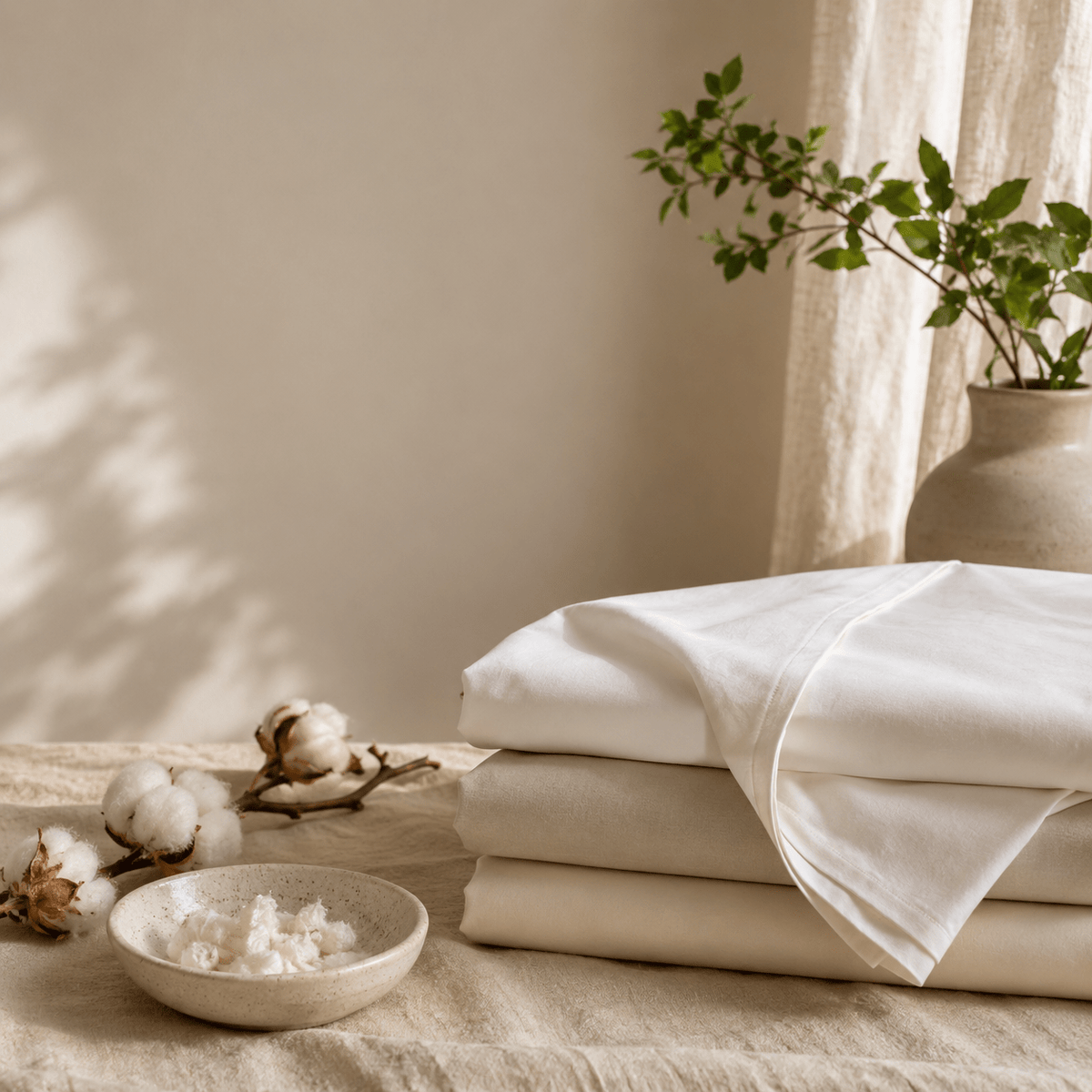
Two bedsheets can share the exact same thread count and still feel like they belong to different worlds. One softens with every wash, holding its shape and its cool, smooth hand for years. The other pills within a season, thins out, and never quite loses that faint stiffness. The difference usually has nothing to do with the number printed on the label. It has to do with something far less talked about: staple length, or how long the individual cotton fibres are before they're spun into yarn.
What thread count leaves out
Thread count tells you how many threads are woven into a square inch of fabric. It's a useful number, but it says nothing about the quality of the cotton itself. You can weave a high thread count fabric from short, weak fibres and still end up with a sheet that pills, sheds lint, and wears thin quickly. Fibre length is the quieter variable that determines how a cotton fabric actually behaves over years of use, not just how it feels on the shelf.
What "staple length" actually means
Raw cotton is made of individual fibres, and their length is classified into rough bands: short staple, long staple, and extra-long staple. Longer fibres can be spun into finer, more continuous yarns with fewer loose fibre ends poking out of the surface. That's what gives long-staple cotton its characteristic smoothness and its resistance to pilling. Shorter fibres, by contrast, need more twist and more ends tucked in to hold together, which is exactly what creates that rougher, fuzzier texture and the little balls of lint that show up after a few washes.
The USDA's Cotton and Tobacco Program, which classes nearly every bale of cotton grown in the United States, measures fibre length as one of its core quality metrics precisely because it correlates so strongly with yarn strength and uniformity. It's a technical, unglamorous measurement, but it's the closest thing the textile world has to an objective answer for "why does this cotton feel better."
How to spot it while you're shopping
Most everyday labels won't print a staple length, so you're left reading the surrounding clues:
- Look for the words "long-staple," "extra-long staple," Pima, Egyptian, or Suvin cotton — these are the varieties known for longer fibres.
- Run your hand across the fabric. Long-staple cotton tends to feel smoother and slightly cooler to the touch, even before the first wash.
- Ask how the fabric behaves after repeated washing. A retailer who can speak to durability and pilling resistance, not just softness on day one, is usually working with better raw material.
- Treat thread count as one data point, not the whole story. A well-made 300 thread count sheet from long-staple cotton will often outlast and outperform an 800 thread count sheet from shorter fibres.
Fibre length and weave are two different decisions
It helps to keep two choices separate. Staple length is about the raw material — how long and fine the individual fibres are. Weave is about how those spun yarns are then constructed into fabric, and that's where percale and sateen come in. A crisp percale weave and a smooth, lustrous sateen weave can both be made from long-staple cotton — the weave affects how the fabric drapes and breathes, while the fibre length affects how fine, strong, and long-lasting the yarn itself is. Getting both right, good fibre and a weave suited to how you sleep, is what separates sheets that age gracefully from ones that don't.
Caring for long-staple cotton so it lasts
Good fibre still needs good care. Wash in cool to warm water, avoid overloading the machine so fibres aren't crushed against each other, skip the fabric softener (it coats fibres rather than conditioning them), and let sheets air dry or tumble dry on low. Over time, this kind of gentle handling is what lets long-staple cotton show its real advantage: fabric that gets softer, not weaker, with age.
Choosing sheets this way takes a little more attention than glancing at a number on a label, but that's rather the point. A slower, more informed decision at the point of purchase tends to pay for itself many times over in a drawer that doesn't need replacing every year. If you'd like to feel the difference for yourself, our home linen collection is a good place to start, and you can always find more on textile care and quiet, considered living over on the journal.