
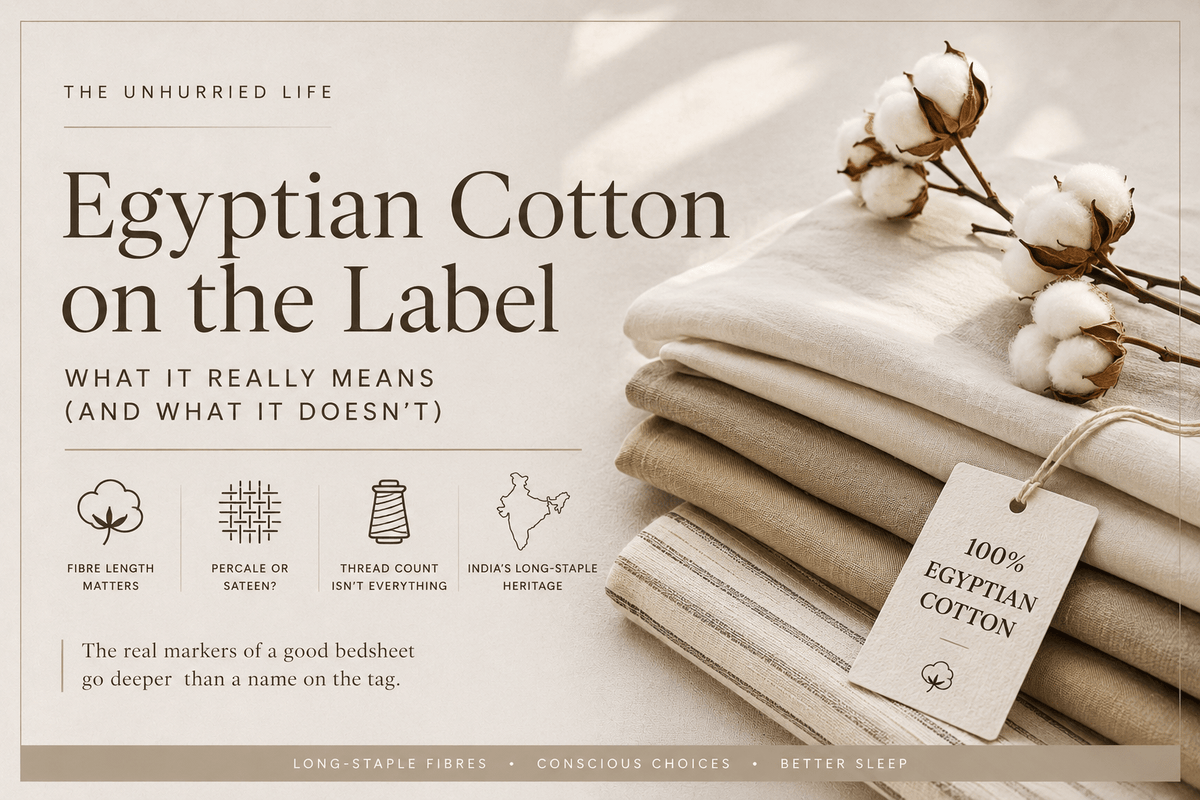
Walk through any bedding aisle, online or otherwise, and one phrase does most of the heavy lifting: Egyptian cotton. It sits on packaging like a seal of quality, often without much explanation of what it actually means or whether the sheets in front of you truly qualify. For a purchase you'll spend roughly a third of your life lying on, it's worth understanding what that label is really telling you — and what it isn't.
What "Egyptian cotton" actually refers to
Egyptian cotton is an extra-long staple (ELS) variety, meaning its individual fibres run longer than standard cotton — often beyond 1.4 inches, with the finest Giza varieties exceeding 2 inches. Fibre length matters because longer strands can be spun into finer, stronger yarn with fewer joins, which translates to a smoother fabric that resists pilling and softens beautifully over time. Sleep Foundation's material guide notes that true Egyptian cotton is hand-picked in Egypt, and that both the location and harvesting process are what yield those exceptional fibres.
That's the real story. The trouble is that "Egyptian cotton" has become a marketing category almost as much as a botanical one. Because true Egyptian ELS cotton makes up a tiny fraction of global production, a significant share of sheets sold under the name are blended, mislabeled, or spun in mills with no verifiable link to Egyptian fields at all. The label alone can't tell you which one you're holding.
India has its own long-staple heritage
It's easy to assume premium cotton is something India imports. It isn't. Suvin, developed in Tamil Nadu as a cross between Egyptian Sujata and a Sea Island cotton variety, is considered one of the finest extra-long staple cottons grown anywhere — in the same fibre-length class as premium Giza cotton. India also grows substantial volumes of other long-staple varieties that go into good-quality percale and sateen weaves without ever touching an "Egyptian cotton" label.
The point isn't that Indian cotton is automatically superior — it's that the country of origin printed on a swing tag is a much weaker signal of quality than people assume. A sheet made from well-processed Indian long-staple cotton can easily outperform a loosely-verified "Egyptian cotton" sheet that's cut corners elsewhere.
What actually determines how a sheet feels and lasts
If the fibre name on the label isn't the full picture, three things generally are:
- Fibre length. Long-staple cotton, regardless of where it's grown, produces smoother, more durable yarn than short-staple cotton.
- Weave. A percale weave is crisp, matte, and breathable — ideal for warm nights. A sateen weave is smoother and slightly more lustrous, with a bit more warmth and drape. Neither is "better"; they suit different sleepers.
- Finishing and thread count. A well-finished sheet in the 300–400 thread count range, evenly combed and properly woven, will usually feel and wear better than an inflated, poorly finished 800-count sheet. Sleep Foundation's own guide points out that thread counts above roughly 600 often stop adding any real benefit, and very high numbers can be a sign of inflated double- or triple-ply counting rather than genuine quality.
If you're deciding between the two main weaves, our percale collection and sateen collection are a useful place to feel the difference for yourself, rather than relying on a label to make the decision for you.
How to buy without chasing a name
A few questions serve you better than the words "Egyptian cotton" ever will. Is the cotton described as long-staple or extra-long staple, regardless of country? Is the weave named clearly — percale or sateen — rather than left vague? Is the thread count in a sensible range for that weave, or suspiciously high? Does the seller explain where and how the cotton is processed, or just lean on a country name?
None of this is about distrust for its own sake. It's the same instinct behind slow living more broadly: choosing things for what they actually are, not for the story printed on the outside. A sheet earns its place on your bed through how it feels against your skin over months of use, not through a word on a tag. Our home linen collection is built around that idea — long-staple cotton, clearly described weaves, and no unnecessary claims.
The quieter conclusion
Egyptian cotton isn't a myth. When it's genuine, it's an excellent, legitimately premium fibre. But it's one variety among several excellent long-staple cottons, including some grown right here in India, and it's far from the only signal of a well-made sheet. The next time a label leans hard on origin and light on detail, it's worth pausing — the fibre length, the weave, and the finishing will tell you far more than the name ever will.
For more on how the small, unhurried decisions around your bedroom add up, browse the rest of our journal.