
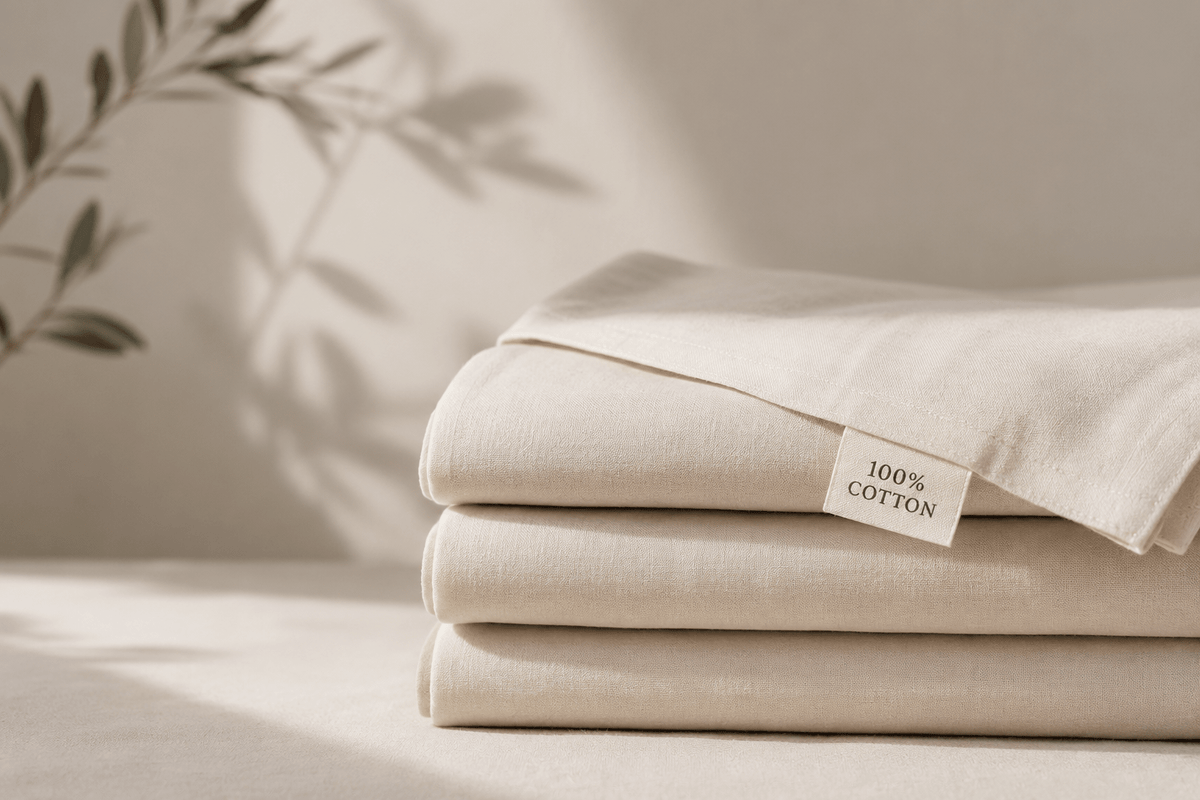
"100% cotton" is one of the most printed phrases in the bedding aisle, and one of the least verified. A label can say almost anything before anyone checks. For a brand built on slow living, this matters more than it might seem — the whole idea of an unhurried home rests on trusting what's actually in it, not just what the tag claims.
The good news is that you don't need a lab to get reasonably sure of what you're sleeping on. A few simple checks, paired with an understanding of what real certifications do and don't cover, will tell you most of what you need to know.
Why the Label Alone Isn't Enough
Fibre content laws vary by country, and enforcement is inconsistent. A sheet can legally be labelled "cotton" in some markets even with a significant polyester blend, especially in the finishing layer that gives cheaper sheets their initial soft, silky feel. That sheen often fades within a few washes, which is usually the first clue something wasn't quite what it claimed to be.
Three Simple Tests You Can Do at Home
- The crease test. Scrunch a corner of the fabric tightly in your fist for a few seconds, then release. Pure cotton wrinkles readily and holds a soft crease. Polyester and poly-cotton blends spring back almost flat.
- The water test. Place a drop of water on the fabric. Genuine cotton is absorbent and the drop should soak in within a few seconds. Synthetic fibres are hydrophobic, so the drop tends to bead and sit on the surface.
- The burn test (on a spare thread). Pull a loose thread and hold it briefly to a flame in a well-ventilated space. Cotton burns steadily with a warm, papery smell and leaves a soft grey ash. Synthetics melt, curl away from the flame, and leave a hard bead — and often a sharper, plastic-like odour.
No single test is conclusive on its own, but two or three in agreement give you a fairly confident answer.
What Certifications Actually Verify
Independent certifications are more reliable than a hangtag, but it helps to know what each one is actually checking.
GOTS (Global Organic Textile Standard) traces the fibre back to the farm, confirming it was grown organically and processed without prohibited chemicals at every stage, from ginning to finishing. It's less about what touches your skin and more about how the cotton was grown and handled along the way. You can read the full standard on the official GOTS site.
OEKO-TEX Standard 100 works differently — it tests the finished fabric for roughly 350 substances that could be harmful to human health, including formaldehyde and azo dyes, and is especially relevant for anything in direct, sustained contact with skin, like bedsheets. Details on what the label covers are on the OEKO-TEX site.
Neither certification alone guarantees a fabric is 100% cotton by fibre content — that's a separate claim — but a brand that has bothered to certify its processing is also far more likely to be straightforward about fibre content, because both point to the same underlying discipline: no shortcuts.
Reading a Product Listing Like You Mean It
Beyond the fibre question, a few numbers tell you what kind of cotton sheet you're actually buying. Thread count and GSM describe density and weight, while the weave — percale or sateen — describes how the threads are interlaced, which shapes texture and temperature far more than thread count alone. A listing that specifies weave, GSM, and fibre origin (rather than just "premium cotton") is usually written by someone who understands the material, not just the marketing.
Why It's Worth the Trouble
None of this is about distrust for its own sake. It's about the same principle that runs through every corner of an unhurried home: choosing fewer things, and knowing them well. A sheet that's genuinely 100% cotton breathes differently, softens with age instead of pilling, and simply lasts — which, in its own quiet way, is the more sustainable and the more restful choice. Browse the full range of home linen to see how we describe our own fabric, weave, and origin in the same detail we'd want to see as a buyer.