
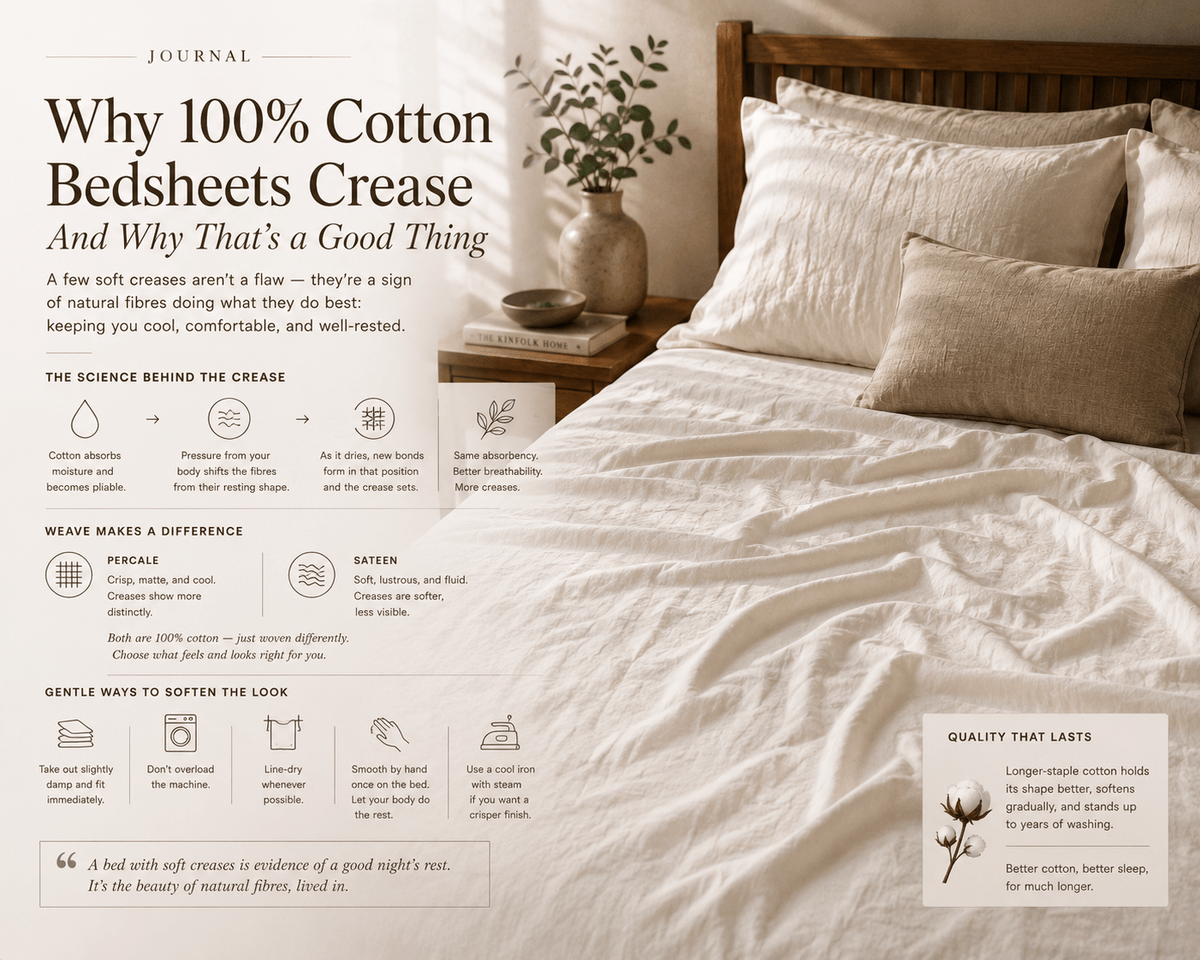
Pull a 100% cotton sheet fresh from the line or the dryer and, within a day of sleeping on it, it will have softened into gentle creases along the places where your body rested. For anyone raised on the crisp, pressed look of hotel bedding or the smooth sheen of synthetic blends, this can read as a flaw — something to iron away or apologise for. It isn't. It's simply what a natural fibre does, and understanding why can change how you feel about the sheets on your bed.
The Fibre Science of a Cotton Crease
Cotton is almost entirely cellulose, a fibre that absorbs moisture readily. When a cotton fibre takes on water — from humidity, perspiration, or a damp night — the hydrogen bonds holding its internal structure in place loosen, and the fibre becomes pliable. Any pressure at that point, a shifting elbow, the weight of a knee, a fold in the wash, displaces the fibre from its resting shape. As the fibre dries, new hydrogen bonds form in that displaced position, and the crease sets in.
Unlike wool, whose crimped structure acts like a small spring and bounces back after being bent, cotton's flat, ribbon-like fibres have little natural elastic recovery. Research on cotton's thermal behaviour confirms this: dry cotton stays springy below roughly 120°F, but moisture lowers that threshold considerably, which is why a cotton sheet creases so easily overnight, when body heat and humidity are both at play (Indiana Public Media, A Moment of Science). It's the same absorbency that makes cotton breathable and cooling that also makes it prone to creasing. You cannot really have one without the other.
Percale, Sateen, and How Weave Changes the Way Creases Show
The weave has as much influence on visible texture as the fibre itself. A crisp percale weave — one thread over, one thread under — has a matte, papery hand that shows creases more distinctly, in the way a linen tablecloth does. A sateen weave, with more threads floating over the surface before going under, catches light differently and tends to disguise creasing under its soft lustre. Neither is more '100% cotton' than the other; they simply wear their texture differently. If a smoother look matters more to you than a matte one, it's worth choosing between our percale collection and our sateen collection with that in mind, rather than assuming one is somehow more prone to wrinkling than the other.
The Slow Living Case for a Few Soft Creases
There's a reason the pressed, hotel-perfect bed has become such a strong visual shorthand for luxury — it signals effort, staff, ironing boards. But an unhurried home runs on a different logic. A bed with the soft creases of an actual night's sleep in it looks lived in, not neglected. It is evidence that the linen is doing its job: absorbing moisture, moving with your body, staying cool through the night rather than sitting stiff and untouched. Treating a slightly rumpled top sheet as a small, acceptable imperfection — rather than a problem to solve every morning — is very much in keeping with the pace this home is meant to hold. You'll find more on that philosophy across our journal.
Gentle Ways to Soften the Look, Without an Iron
- Take sheets out of the dryer while they're still very slightly damp, and fold or fit them onto the bed immediately — the fibres set fewer sharp creases if they finish drying under their own weight.
- Avoid overloading the washing machine. Sheets that have room to move rinse and spin more evenly, which reduces the deep, twisted creases that come from a cramped drum.
- Line-dry where you can. The gentle, gradual drying process tends to leave a looser texture than a hot tumble cycle.
- Smooth the sheet flat by hand once it's on the bed. Most surface creases relax simply from the weight and warmth of a body sleeping on them for a few hours.
- If you do want a crisper finish for guests or special occasions, a cool iron with a little steam works with the same moisture-and-heat mechanism that causes the creasing in the first place.
What Cotton Quality Actually Has to Do With It
Wrinkling is normal for any 100% cotton fabric, but excessive, deep, hard-to-smooth creasing — or a sheet that looks tired and limp within a few washes — often points to shorter, weaker fibres rather than to cotton itself. Longer-staple cotton yarns hold their shape better wash after wash and soften gradually rather than degrading. It's one more reason fibre quality, not just thread count, is worth paying attention to when you're building out a linen collection you'll actually want to keep using; our home linen edit is a good place to start comparing.
None of this is to say a wrinkle-free look is wrong to want. But it helps to know what you're asking for: a synthetic blend, a resin finish, or a nightly ironing habit, since 100% cotton left to itself will always soften into a few honest creases. Sleep research on natural bedding fibres continues to point to the same trade-off — better breathability and moisture management from cotton correlates with a less pressed, more textured surface (a 2024 systematic review on sleepwear and bedding fibre types). For a home built around slowing down rather than smoothing everything over, that trade feels like an easy one to make.