
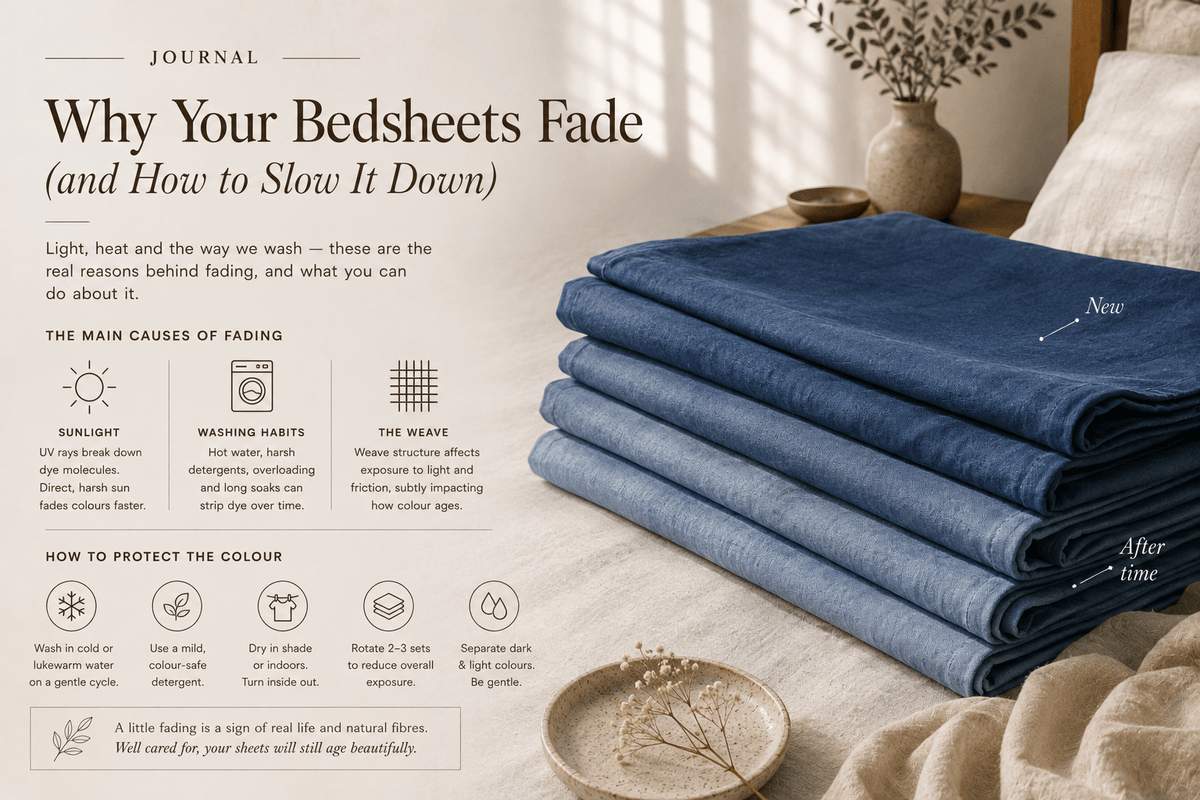
Somewhere between the third wash and the third season, you notice it: the indigo bedsheet that once looked almost inky has softened into a duller, greyer blue. Nothing was spilled on it, nothing mishandled. It simply faded, the way most things in daily use eventually do. This is one of the more quietly disappointing parts of owning good cotton bedsheets — and also one of the more explainable, once you understand what is actually happening to the dye.
What Fading Really Is
Colour in a cotton bedsheet comes from dye molecules bonded to the cotton fibre. Those bonds are chemical, and chemical bonds can be broken — by light, by heat, and by the mechanical stress of washing. When enough bonds break down, the dye stops reflecting colour the way it once did, and the fabric reads as paler, cooler, or greyer than before. Researchers call this photodegradation when light is the driving cause, and it has been studied in some detail. A peer-reviewed study on reactive-dyed cotton fabric found that colour difference increased steadily and measurably with UV exposure dose, confirming what most of us already sense: the more sun and the more washing a sheet sees, the sooner its colour begins to shift.
Sunlight Is the Biggest Culprit
Ultraviolet light carries enough energy to break the chemical bonds holding dye molecules in place, which is why sheets dried in direct, harsh sun fade faster than those dried in shade or indoors. This matters more in India than in cooler climates, where sunlight is intense for most of the year. A gentle habit fix: dry your sheets inside out, or in dappled rather than direct midday sun. You still get the outdoor freshness without handing your dye pigments over to a few hours of concentrated UV.
Washing Habits That Speed Things Up
Fading is not only a light problem. Every wash cycle adds mechanical stress, and certain habits accelerate colour loss further:
- Hot water opens the cotton fibre more than warm or cool water, letting dye molecules loosen and rinse away faster.
- Harsh or bleach-based detergents strip dye along with dirt, especially on darker or saturated colours.
- Overloading the machine increases friction between fabrics, which wears down both fibre and colour.
- Long soak times in standing water can leach dye, particularly in the first few washes of a new sheet.
None of this means you should wash less often — clean sheets matter for skin and sleep hygiene. It simply means washing a little more gently: cooler water, a mild detergent, and a full but not overstuffed load.
Weave Also Plays a Quiet Role
The way a fabric is woven affects how much light and friction actually reach the dyed fibres. A tightly woven percale sheet has a dense, matte, crisscross structure that exposes less fibre surface at a time, while a sateen sheet, woven with longer floats for its characteristic sheen, can show fading and sheen loss a little differently, particularly along the parts that catch the most light on an unmade bed. Neither weave is more or less prone to fading in absolute terms — it mostly comes down to dye quality and everyday care — but it explains why two sheets in the same colour, one percale and one sateen, can seem to age slightly differently.
How to Protect the Colour, Practically
- Wash in cold or lukewarm water on a gentle cycle.
- Use a mild, colour-safe detergent and skip the bleach.
- Dry in shade or indoors when possible; if line-drying outside, hang inside out.
- Rotate two or three sets rather than relying on one, so no single sheet takes the full weight of daily UV and wash exposure.
- Separate dark and light colours, and avoid washing new, deeply saturated sheets with pale ones for the first few cycles.
When a Little Fading Is Fine
There is also a slower, more forgiving way to look at this. A cotton sheet that softens in colour along with its weave, that starts to feel a little more worn-in and a little less new, is simply behaving like a natural, breathable, undyed-in-plastic material would. It is not a flaw so much as evidence of use — of years of good sleep, of a bed that has actually been lived in. In a slower home, that kind of gentle fading can sit comfortably alongside function rather than working against it. If you want to read more on caring for natural fibres over time, the journal has further notes on textile care and the slow-living philosophy behind it.
Either way, understanding why fading happens — light, heat, and the mechanics of washing — puts the choice back in your hands: fight it a little with gentler habits, or let it happen slowly, and let your sheets earn their softness honestly.