
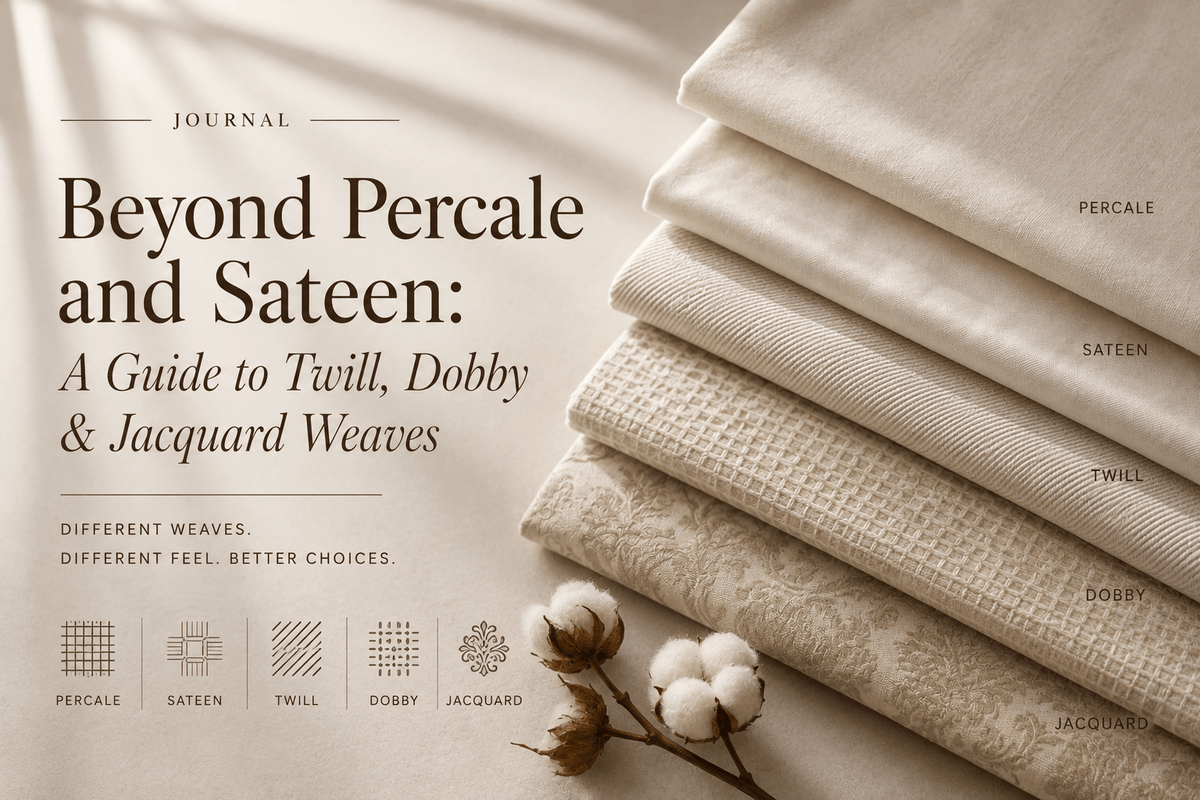
Most conversations about cotton bedsheets stop at two words: percale and sateen. They are a useful starting point, but not the whole story. Weave is simply the pattern in which threads interlock on the loom, and beyond the plain weave of percale and the satin weave of sateen sits a quieter family of constructions — twill, dobby, and jacquard — each shaping how a sheet feels, drapes, and ages on your bed. Knowing the difference helps you choose cotton bedsheets that actually suit your climate, your skin, and the kind of bedroom you are trying to build.
What weave actually determines
Every woven fabric is built from two sets of threads: the warp, running lengthwise on the loom, and the weft, running crosswise. How these threads cross each other — over one, under one; over two, under two; in a diagonal step; in a raised pattern — is the weave. It has nothing to do with fibre quality or thread count, and everything to do with texture, drape, sheen, and durability. Two sheets can share the same long-staple cotton and the same thread count and still feel completely different because of how they are woven.
Twill: the diagonal weave you already own
Twill is one of the three foundational weaves in textile-making, alongside plain and satin. The weft thread passes over one or more warp threads, then under two or more, shifting slightly with each row to create the visible diagonal rib you would recognise from denim or a herringbone jacket. In bedsheets, twill cotton has a substantial, slightly textured hand and a subtle sheen along its diagonal lines. It resists wrinkling better than a plain weave and tends to hide the small imperfections of daily use, which makes it a practical choice for a bed that is made and unmade often.
Dobby: texture without print
Dobby weaves use a special loom attachment to raise and lower individual warp threads, producing small, repeated geometric patterns — the fine grid of a waffle or the subtle dot of a bird's-eye piqué are both dobby constructions. Because the pattern is woven rather than printed, it does not fade, crack, or wash out the way surface prints eventually can. On a bedsheet, this shows up as a gentle, tactile texture rather than a visual pattern — something you notice more with your hands than your eyes, which fits a bedroom built around sensation rather than decoration.
Jacquard: pattern built into the cloth
Jacquard is the most complex of the three. Using a specialised loom mechanism that controls each warp thread independently, it can weave intricate, large-scale patterns — florals, damasks, geometric motifs — directly into the structure of the fabric rather than onto its surface. This is why jacquard cotton often has a faint dimensionality when you run a hand across it; the pattern has actual depth, not just colour. It is a heavier, more formal weave, better suited to a statement duvet cover or a guest room with a slightly dressier feel than to an everyday fitted sheet.
Where percale and sateen still fit
None of this makes percale or sateen less relevant — they remain the two most practical everyday weaves for cotton bedsheets, and for most Indian bedrooms, one of them is still the right answer. Percale's plain weave keeps things crisp, cool, and matte, which suits humid or hot-sleeping climates. Sateen's satin weave gives a smoother, more lustrous surface with a bit more drape and warmth, better suited to cooler months or a softer feel underhand. Twill, dobby, and jacquard sit alongside these as specialty options — worth knowing when you want texture, durability, or a decorative layer that a flat weave cannot offer, rather than a replacement for your everyday sheets.
Weave and how a bed actually feels to sleep in
Weave affects more than aesthetics. Denser, tighter constructions like twill and jacquard tend to trap slightly more heat than the open, plain weave of percale, simply because of how the threads sit against each other and against your skin. Since airflow and moisture movement play a real role in how well you sleep, particularly through a warm night, it is worth matching the weave to the season and the room, not just the pattern you like the look of. The Sleep Foundation notes that a cooler sleep surface supports the natural drop in core body temperature the body needs to fall and stay asleep — one more reason a heavier decorative weave might belong on a spare bed rather than the one you sleep in every night.
Choosing with intention
A simple way to think about it: reach for percale or sateen for the sheets that touch your skin most nights, and consider twill, dobby, or jacquard for pieces that add texture or occasion — a table runner, a guest room duvet, an armchair throw. Slow living is not about collecting more textile vocabulary for its own sake; it is about understanding your materials well enough to choose them on purpose, rather than by habit. For more on how the everyday details of a bedroom add up to a calmer one, our journal has further reading on fabric, care, and the small decisions that shape rest.