
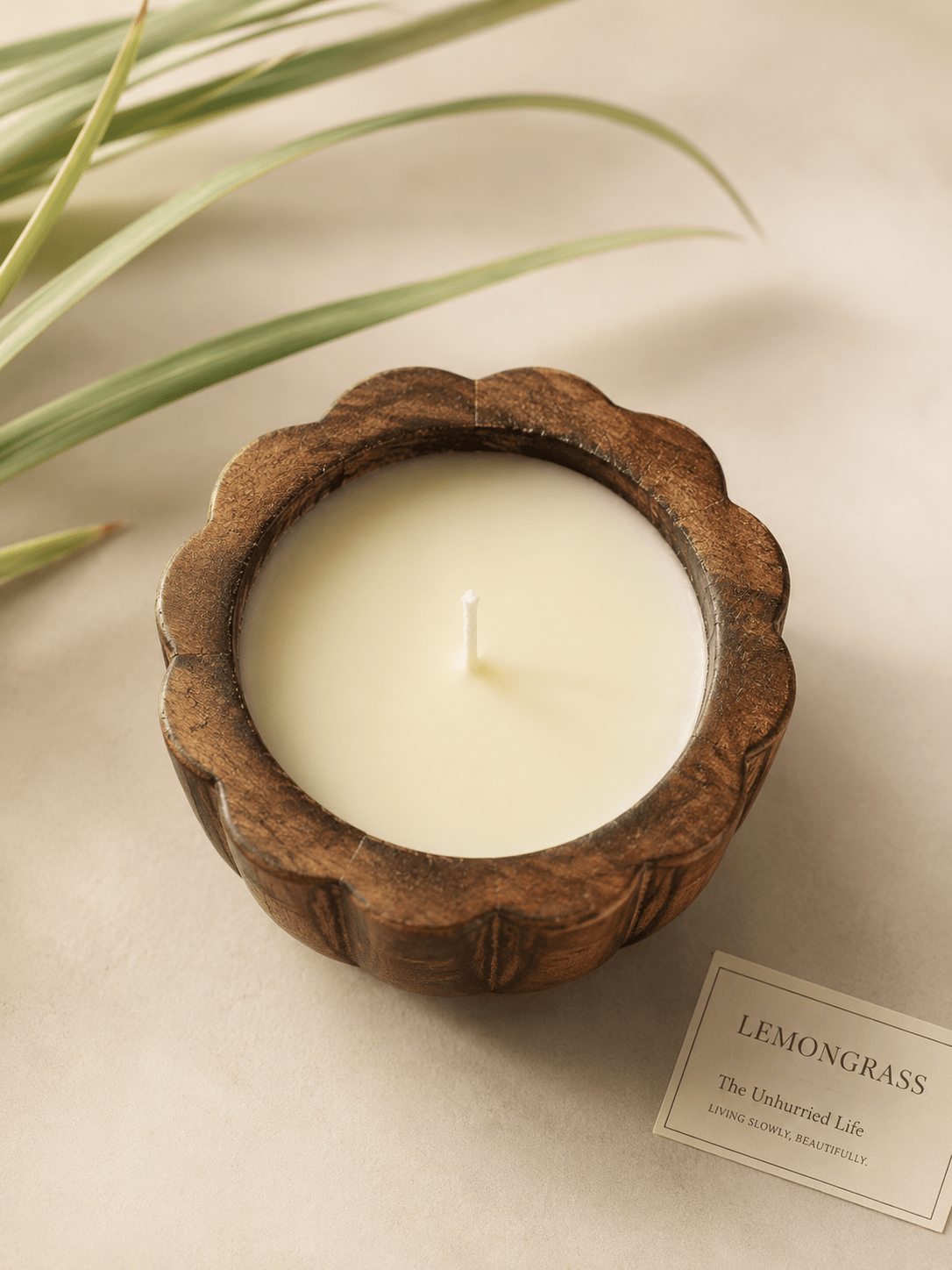
The phone is almost never far from reach — on the desk, face-up, one notification away from pulling your attention somewhere else. Most attempts to fix this involve more technology: app timers, blockers, do-not-disturb schedules. A candle works differently. It doesn't manage your attention through restriction. It simply gives you something quieter to look at, and a visible, honest measure of the time you've chosen to spend undistracted.
Why a Flame Works as a Focus Cue
Rituals exist to lower the effort it takes to begin something difficult. A 2018 review of Cal Newport's research on deep, distraction-free work, published in the academic journal Vikalpa, describes how consistent starting routines reduce the willpower needed to enter a state of real concentration — the same reason athletes have pre-game rituals and writers have specific desks. Lighting a candle before you sit down to read or work is a small, repeatable version of the same idea: it marks a clear boundary between scrolling and stillness, so your mind doesn't have to negotiate the switch every time.
Using a Candle as a Manifestation Practice
Some people use this same window differently — not for a task, but for a goal. Lighting a candle and sitting with a single intention in mind, for as long as it burns, is an old and simple form of manifestation practice. There's no requirement to believe in anything mystical for it to work as intended: the act of naming what you want and giving it a few uninterrupted minutes of real attention, without a screen competing for it, is often the part that's been missing.
What makes this different from simply writing a goal down once is the repetition. A candle lit most evenings, with the same intention returned to each time, works the way any rehearsed thought does — it becomes easier to hold, and harder to lose track of amid everything else competing for your attention during the day.
A Simple Focus Candle Practice
- Put your phone in another room, or at minimum, out of arm's reach and on silent.
- Light the candle and name one thing — a task, a chapter, a goal you're holding in mind — before you begin.
- Stay with it until the flame has visibly shortened, or until a set point you've decided on beforehand.
- Blow it out deliberately. This close is as much a part of the ritual as the lighting — it marks the return to the rest of your day.
Why This Isn't Just Aesthetic
A candle has no notifications, no auto-play, no algorithm deciding what comes next. It burns at its own pace regardless of what you do, which is precisely why it works as an anchor — it can't be rushed or scrolled past. Keeping a candle near your reading chair or desk turns this into something you reach for without much thought, the same way a made bed or a folded set of sheets makes stillness a little easier to find elsewhere in the house.
Morning Focus, Evening Wind-Down
The same ritual reads differently depending on when you light it. In the morning, before the day's messages have started arriving, it can mark the start of the one task you'd most like to give real attention to. In the evening, it works the other way — a signal that the working day is closed, and what's left of the evening belongs to a book, a conversation, or simply doing nothing in particular. Either way, the value isn't in the candle itself. It's in having a fixed, physical marker for a boundary that a phone, left to its own devices, will never draw for you.
A Few Practical Notes
Keep the candle somewhere stable and away from papers or curtains, and never leave it burning in a room you're about to leave for long. A smaller candle that burns for 30–45 minutes suits a single reading session or a short work sprint well; a larger one is better kept for longer stretches of writing or study, where you'd rather not relight partway through.
For more on building small, unhurried rituals into an ordinary day, visit our journal.