
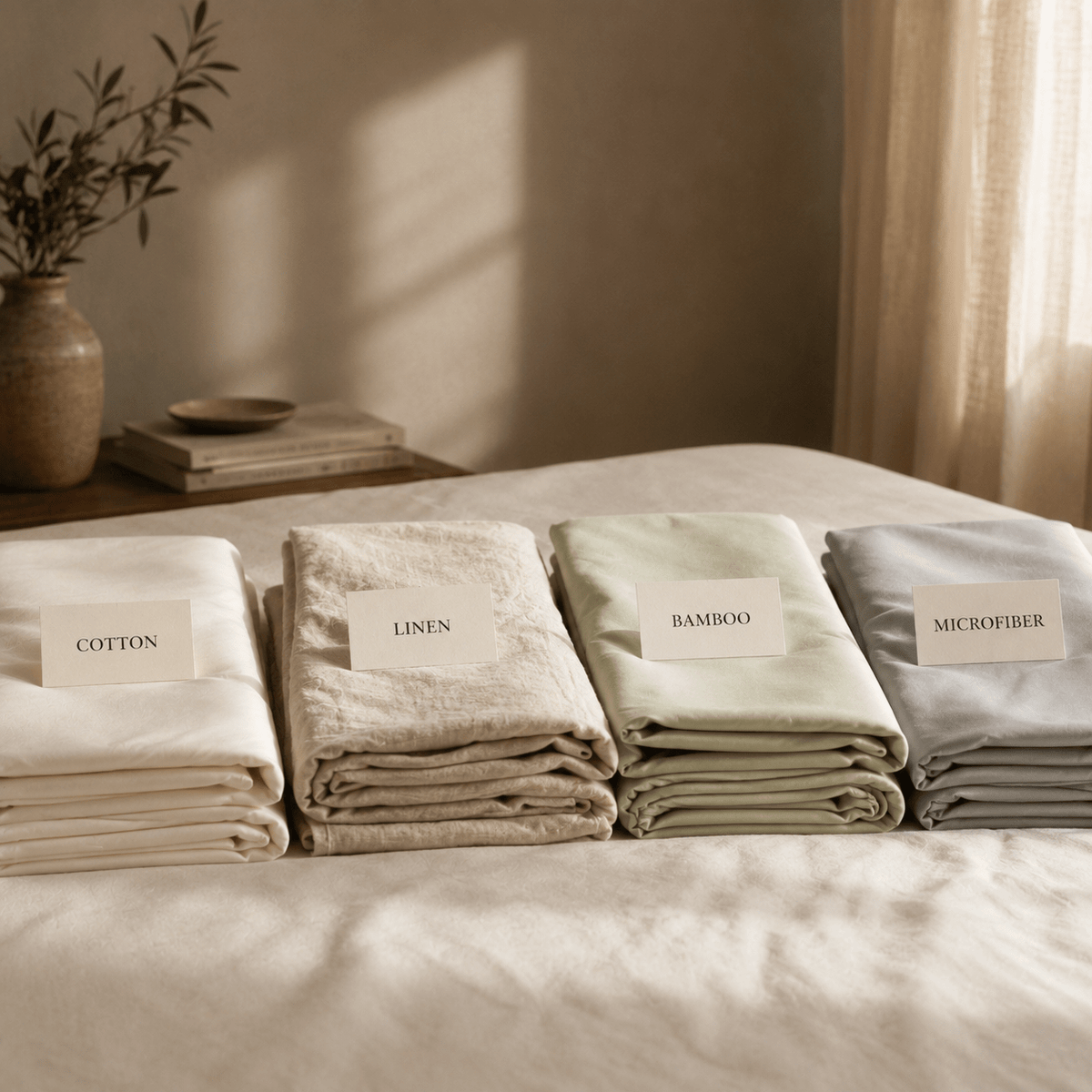
Every few months, a new fabric arrives with a bold claim: cooler than cotton, softer than silk, more sustainable than anything before it. It is worth pausing before switching sheets on the strength of a claim alone. Cotton, linen, bamboo, and microfiber each behave differently on a bed, and the differences are not marketing — they come down to how each fibre handles moisture, heat, and time. Here is what genuinely separates them.
Cotton: The Reliable Middle Ground
Long-staple cotton remains the benchmark for a reason. It breathes well, absorbs moisture rather than trapping it against the skin, and softens with every wash instead of wearing thin. Woven as percale, it feels crisp and cool; woven as sateen, it takes on a soft, lustrous drape. Its main trade-off is that it does not wick moisture away quite as fast as bamboo does, though for most sleepers in most climates, that difference is barely noticeable. Cotton also has the advantage of being easy to care for, widely available in genuinely long-staple quality, and durable enough to last for years rather than seasons — you can browse our home linen collection to see the range this weave versatility allows.
Linen: Textured, Breathable, Slow to Soften
Linen, made from flax, is prized for how much air it lets through. Its open weave and slightly stiff hand make it the coolest option on a hot night, and its texture is part of its appeal for anyone drawn to a more relaxed, lived-in look. The trade-off is patience: linen takes longer to soften than cotton, wrinkles more visibly, and tends to sit at a higher price point. It rewards people who are not in a hurry — which, fittingly, is much of the appeal.
Bamboo: Cool to the Touch, With Caveats
Bamboo-derived fabrics, usually sold as bamboo viscose or lyocell, have a genuinely silky feel and strong moisture-wicking properties, often marketed as running slightly cooler than cotton through the night. What is less discussed is that "bamboo sheets" are almost always a heavily processed rayon, not a woven bamboo fibre, and the chemical-intensive viscose process has real environmental trade-offs that the branding rarely mentions. The fabric itself performs well for hot sleepers; the story behind how it gets there is worth knowing before choosing it purely on its "natural" label.
Microfiber: Affordable, but Not Built for Breathability
Microfiber's biggest strength is price and immediate softness out of the packet. Its weakness is exactly the thing that matters most for sleep quality — breathability. Because it is a tightly woven synthetic, it tends to trap heat and moisture rather than let them escape, which can make a bed feel warmer and slightly damp overnight compared with natural fibres. For a guest room or a budget-conscious first set, it has its place. As an everyday sheet for someone who runs warm at night, it is usually the wrong trade-off.
What the Sleep Research Actually Shows
This is not just a matter of preference. A 2024 systematic review in the Journal of Sleep Research examined how sleepwear and bedding fibre types affect sleep quality, and found that thermal and moisture-handling properties of a fabric meaningfully influence skin temperature, microclimate, and how restfully people sleep through the night (source). In practice, this lines up with what most sleepers notice on their own: a fabric that manages heat and moisture well tends to produce fewer disrupted nights, regardless of how soft it feels on first touch in a shop.
Choosing Without the Hype
There is no single "best" fabric for everyone — climate, budget, and personal preference for texture all matter. But if you want one fibre that performs consistently well across breathability, durability, ease of care, and honest sourcing, long-staple cotton remains the least complicated choice. It does not require a chemical process to feel soft, does not trap heat the way synthetics do, and only improves with age and washing. If you sleep warm and want the crispest option, our percale collection is a good place to start. For more on how we think about fabric, care, and slowing down at home, our journal has further reading.
The right sheet is rarely the one with the loudest claim. It is the one you stop noticing because it simply does its job, night after night.